
Free sample. This chapter is one of two shared free from the book. Buy the complete book.

LONE PINE
“When old hands of the battalion foregather and talk Gallipoli and the “Pine”, Host’s actions are retold. His powerful stride took him to the front of the attackers, and tearing the timber away from the top of the Turkish trenches, he leaped in and used his rifle as a club.”
Captain Ken Millar

Section 3 - Lone Pine: August 6-9 3a Gallipoli - The August Offensive
On August 6 1916, there began the second major struggle to seize control of the Dardanelles. The co-ordinated attacks were part of a complex plan known as the August Offensive. This military thrust aimed at nothing less than victory, which was to be achieved by driving the enemy from the heights of Chunuk Bair and positioning the Allies for an advance on the Turkish rearguard from across the peninsula . If the move had succeeded, the original objective of seizing the Straits of the Dardanelles would have been achieved and the UK Navy could have sailed triumphantly through to Constantinople.
During the planned offensive, Chunuk Bair and Koja Temen Tepe (Hill 971), a higher peak further north, were to be seized in a complex set of actions involving New Zealand, Australian, British and Indian troops. The plan called for the Allied soldiers to carry out an attack on the Turks before sunset on 6 August from the North Beach area of Anzac Cove. That same evening, a British force was to land further to the north at Suvla Bay and begin pushing its way inland across the plain.
To cover these movements and to make the Turks think that the main attack was happening elsewhere, the biggest “ feint” or distraction was planned for a peak called Lone Pine, so named for a single tree which was a distinctive marker in a largely treeless landscape. At “the Pine”, as the hill was known by the troops, it was planned that the 600 men of the Australian 1st Division of the 2nd Battalion would assault the Turkish line of defensive earth works and capture the enemy’s forward trenches. It was thought that, if the attack were convincing enough, the Turks would think that this was a major effort to break through their lines. Consequently, they would therefore throw their reserves into the attempt to recapture the significant position, thus drawing them away from the main Allied assault at Chunuk Bair and Koja Temen Tepe.
Despite dire warnings about the health and stamina of Australian forces, three units of the ANZAC troops began the attack at 5.30 pm which, at high summer, left about three hours of daylight to break through the Turkish trenches. The task was assigned to companies of the First Brigade of the 2nd Battalion and it was regarded by those men as their most significant operation just as the 3rd had led the way at the Landing and the 2nd had been the main force at the attack on Helles. Walter Host’s C Company was under the command of an officer called Leslie James Morshead. A teacher before the war, Morshead had much in common with Walter because at the outbreak of war he had enlisted as a private after having resigned his position as a school master and a lieutenant of the Cadet Corps. At Gallipoli, his unit had achieved the furthermost advances and on April 28 he had
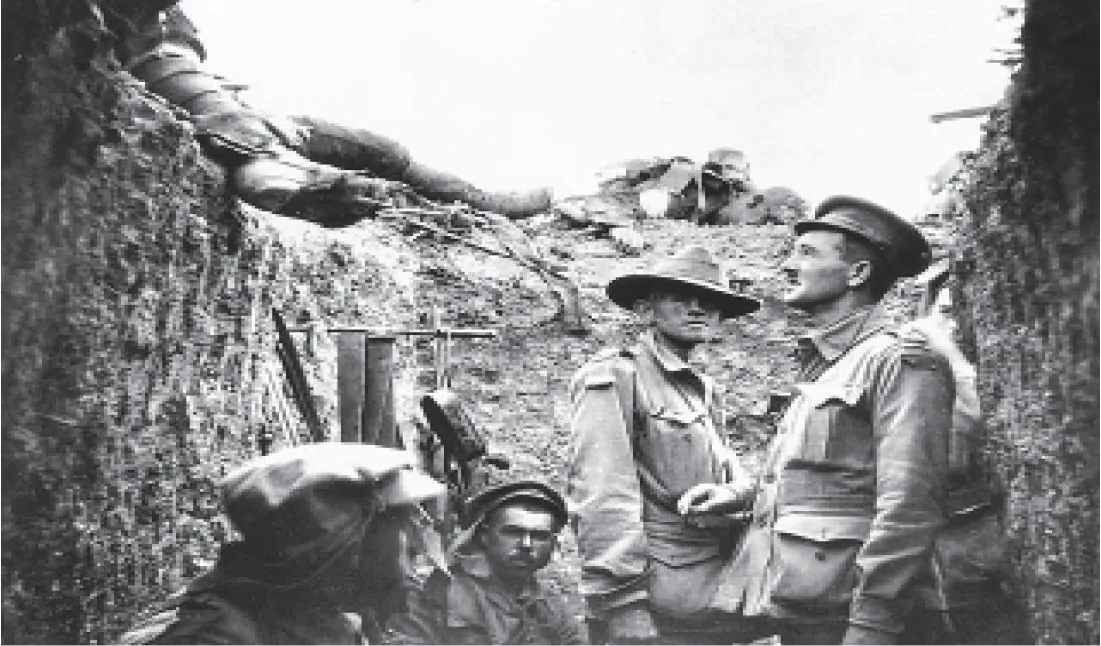
become commander of C Company after being appointed a Major. Morshead had led his company through Turkish attacks in both May and June 1915 and he was again under intense fire on August 8 at Lone Pine. This officer also served with distinction in World War 2.
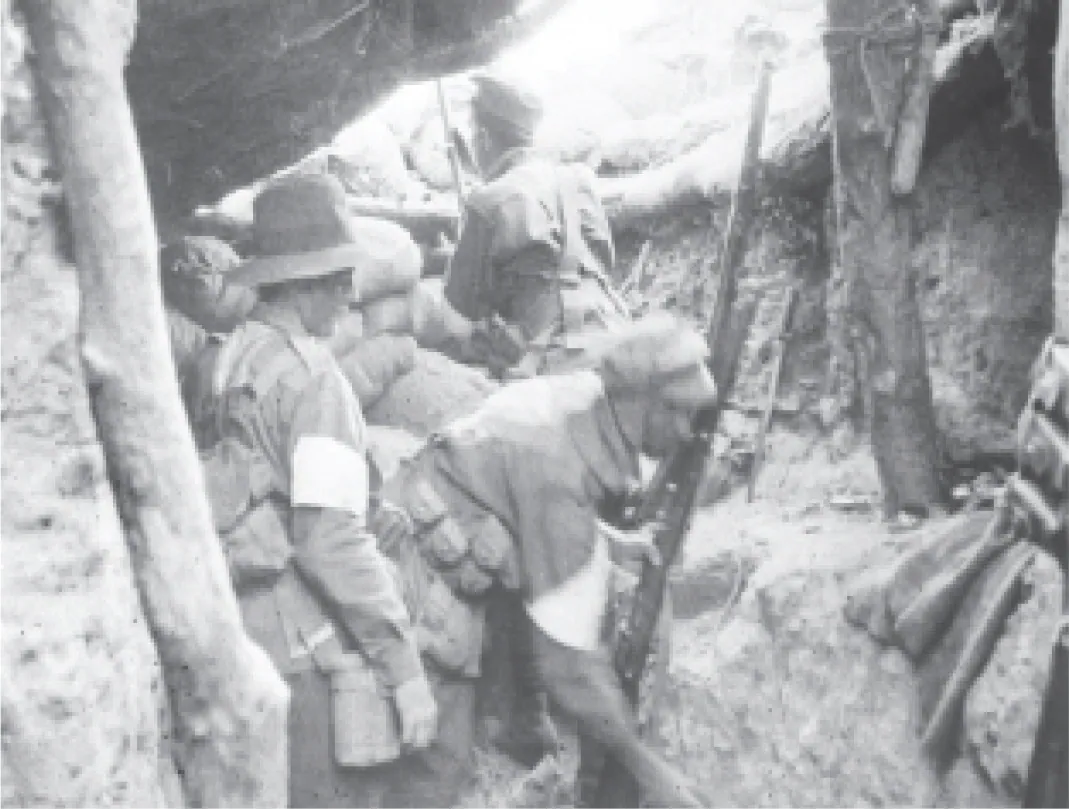
The planning of the assault on Lone Pine was made in a most careful and detailed fashion and for the late afternoon attack, two companies, C and D, were to leave the trenches over the parapet while another company was to begin its assault from underground earth works and tunnels. All participants wore distinctive white arm bands and patches on their uniforms and company leaders received instructions to mark their flanks with flags in an effort to avoid mishaps from “ friendly fire”.
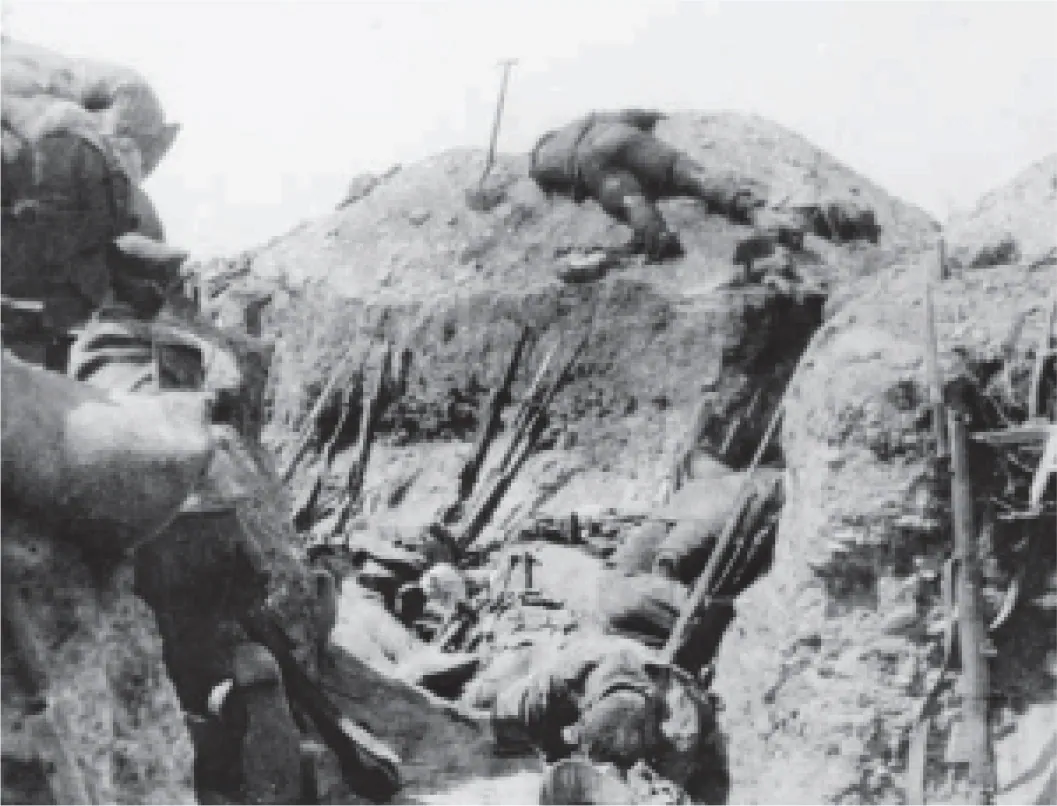
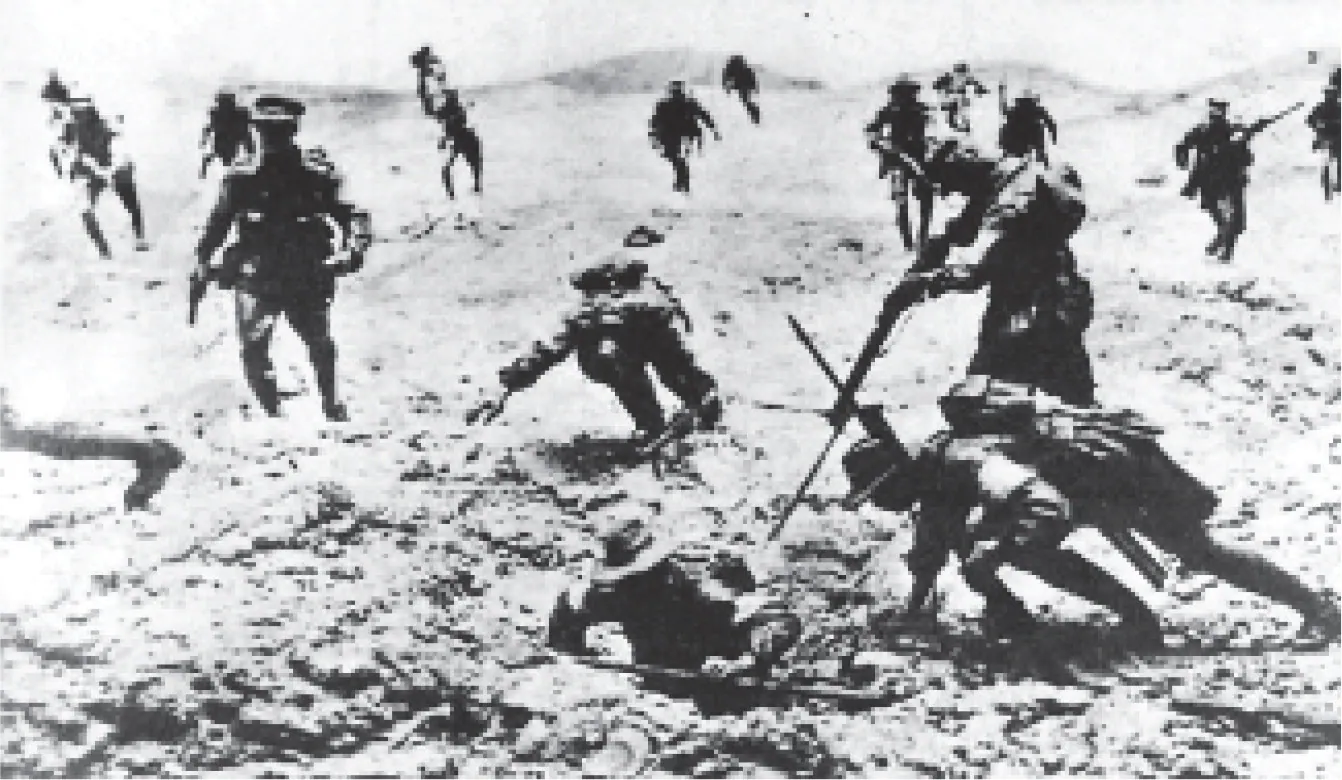
Following a sustained bombardment, the first troops “over the top” encountered limited resistance as they moved forward since the Turks had hardly had time to recover their positions before the ANZACS came charging across the 110 yards of open hillside called the “Daisy Patch”. In many places like Quinn’s Post, opposing trenches were literally “across the road” - being so close that both sides had regularly engaged in “bomb throwing” duels since the trenches were within throwing distance. However, when the leaders of the Aussie charge reached the Turkish trenches they found that the defensive lines were covered with heavy timbers which denied easy entry. Some troops stopped to haul the timbers aside before crashing down among the startled Turks, while other men ran on to the rear communication trenches where they gained entry, before doubling back to clear the crowded trenches with bayonets, trenching tools and even bare hands and fists.
Once again Walter sent a vivid description of the part he had played in the assault on the trenches of Lone Pone when he wrote to his mother, Lizzie, on August 8 1915: “I suppose you have had a very anxious time this last few weeks since you have seen the papers about the glorious charge of the 2nd battalion & the way we gallantly cleared the Turkish trenches & we suffered severe loss in doing so. Well I am one of the few which is left of our battalion, we charged 600 strong & came back with 150, never mind, we have showed the whole world what Australians can do. We went against all the military rules because we charged in daylight over a hundred yards of ground strewn with barb wire. We all reached the first trench together and shot the Turks down like rabbits, then four of us jumped over the first trench & started to shoot the Turks as they were running away, because by this time we had them completely on the run. It was impossible to say how many Turks you killed because so many bullets were hitting them at once. I myself can account for four Turks, one I brained with the butt of my rifle, two others I bailed up in a corner & succeeded in shooting both,
but not till one of them had shot a officer just behind me & the other chap had a hurried shot at me and thank God he missed, then I raced on down the trenches and succeeded in getting the boys to make a firing line. The shrapnel shells & bullets were raining all around us & every second a man go down & I am sorry to say one of the poor lads that was killed was Sgt. Roy Macdonald one of my old Kensington tent mates. I am the only one left on the Peninsular at present out of that tent.”
Ken Millar later heard about Walter’s part in the fight for “the Pine” and he later wrote: “His powerful stride took him to the front of the attackers, and tearing the timber away from the top of the Turkish trenches, he leaped in and used his rifle as a club, and there was many a ‘Harem’ in Turkey, which mourned for its master when ‘Tiny’ had finished”.
However, although Walter had displayed courage of the highest order during the famous charge and was later awarded the Military Medal for his valour in the field, that was only one aspect of his conduct at “the Pine”. In typically tense and soldierly language, Taylor and Cusack in the Battalion history, Nulli Secundus state simply: “C.S.M Host had assumed command of a party whose officers were killed and directed them throughout.”
When Sir Ian Hamilton was informed of Host’s bravery it was the later actions which earned the young company sergeant major special commendation. In the dying days of the Gallipoli campaign Hamilton mentioned in his despatches Walter Host’s leadership of the men after the initial charge, since it had been Walter who had taken command, managed to “steady” the troops and by the force of his commands had persuaded them to fight on when all seemed lost. At that critical point the men had recognised and obeyed the orders of a big man called “Tiny”.
Walter later wrote to his family to report, with characteristic modesty, on the events of that day: “I know you will be glad to know I have been recommended for a D. C. M (Distinguished Conduct Medal) by Major Morshead & our late Colonel Scobie. I don’t think I will get the D C M but I will be mentioned in despatches. I must finish up at once - wanted in the orderly room.”
(Note - Walter was correct about not receiving that award because at that time, the DCM was presented only to officers. That the young non commission soldier was recommended for a medal which could be awarded only to an officer, appears to support Ken Millar’s opinion that the Australian command did not fully appreciate the rigid rules which then applied to the award of military honours. The result was that men like Joe Collingwood and Host “missed” VC awards which they might well have won had they been in British Units.)
In a letter to his brother Herb, Walter later wrote “I daresay you are sick of reading in the papers, about the way in which the Brigade captured some Turkish trenches and how the 2nd Battalion especially distinguished itself. I came through the charge and the rest of 2 day’s fighting without a scratch. I have no idea how I done it. All I can say I was lucky.”
Today the Battle of Lone Pine has become one of the chief icons of the Gallipoli Campaign and the details are well known. In the hours after the troops gained entry to the trenches there followed over the following two days desperate hand to hand fighting within the confusing and dark trench Turkish trench system. This was a battle which historian, Charles Bean, described as “the heaviest of its kind in which Australian troops ever took part”. The fighting was brutal, bloody and confused, as soldiers from both sides attacked with bayonets, bombs, rifles and spades. Seven Australians were awarded the Victoria Cross during the fight, the most in any single Australian action
Having captured and cleared the Turkish trenches, the Australians then held on to their gains while the Turks desperately and determinedly attempted to throw the Australians out of the trenches. From nightfall on 6 August until the night of 9 August, a fierce battle ensued underground in the complex maze of Turkish tunnels. Six Australian units suffered nearly 2,300 killed and wounded at Lone Pine and the Turks at least twice that number of casualties. It is history that the 2nd battalion made the initial attack, were successful in gaining their objectives, then held on, although losing Colonel Scobie and many good officers and men, and were finally relieved by a Victorian Battalion.
However the gains proved to be transient because by 6 am on the third day of the battle fierce Turkish counter-attacks began. Meanwhile, the regiments of the New Zealand Mounted Rifles attacked up the valleys leading to the heights of the Sari Bair Range — Chunuk Bair and Hill 971. After this successful assault, three columns of infantry, the New Zealand Infantry Brigade, the 29th Infantry Brigade of Sikhs and Gurkhas and the 4th Australian Infantry Brigade began making their way up these valleys to attack the heights and at 9.30 pm British units began landing at Suvla Bay. By 4.30 pm four waves of men of the 3rd Australian Light Horse Brigade attacked Turkish trenches at the Nek. They were cut to pieces. Charles Bean wrote “The flower of the youth of Victoria and Western Australia fell in that attempt”.
In the days that followed, the list of failures lengthened although the New Zealanders, with British units in support, captured Chunuk Bair and held it despite strong Turkish counter-attacks. A small unit of Gurkhas briefly captured another summit to the north of Chunuk Bair known as ‘Q’ but, they too, were eventually driven off by the Turks. The 4th Australian Brigade failed to make progress towards Hill 971 and at the same time unsuccessful diversionary attacks were made from Quinn’s Post and Pope’s Post. By the next morning, New Zealand and Indian units attacked towards Chunuk Bair but they, too, failed to capture the peak. Meanwhile, the 4th Australian Brigade became lost in the foothills leading to its objective, Hill 971, and dug in while the British units failed to make any progress at Suvla Bay.
Ultimately, like so much about the Gallipoli campaign and, despite the heroism displayed on both sides, the attacks and counter attacks failed to gain any strategic objectives and it left those who had survived the initial charge and its aftermath exhausted and almost broken men. About all that could be said was that in making their fierce counter-attacks, the Turkish troops had failed as well and another stalemate soon developed. Of the 4,600 Australian soldiers who participated in the battle almost half were killed, while Turkish losses are estimated at between 6000 and 7,500 men. Ironically, although the ANZAC troops held on to the territory which they had gained until the Evacuation of Gallipoli in December 1915, Lone Pine ultimately became a “liability”, being constantly under fire from Turkish artillery and eventually the cost of defending the “prize” was to be the loss of many more lives over the next five months.
3b Gallipoli - After “The Pine”
In the aftermath of the charge on Lone Pine, the 2nd Battalion managed to hold their position. In the next days acts of great bravery took place on both sides as the Turks attempted to regain their trenches. The heroism was exemplified by an officer called Pain who, despite being wounded, mounted a machine gun on the shoulders of three men and managed to discharge nearly one thousand rounds before his gun collapsed - all four men were recommended for V Cs. By the end of the second day, the Second Battalion had only 200 fit men to carry on when a message was sent - “We are still holding the enemy; bomb attacks continue”. In his diary of August 7 the commander, Sir Ian Hamilton, described the action as, “a desperately fine effort”.
Although the Battalion had gained Lone Pine through “dash and daring” they now faced the task of holding their hard won ground despite “severe losses and the continual strain of fatigue and bomb attacks” (Taylor and Cusack - Nulli Secundus). In the weeks that followed, the 22nd and 4th Battalions alternated but, by the end of August, it had become apparent that the condition of the men had deteriorated to such a degree that the majority were no longer fit for duty. As Walter wrote to his brother “We are waiting every day to be relieved as it is time we had a spell. 17 weeks in the trenches in one stretch is know (sic) joke.”
When the fighting petered out on August 10, six Australian battalions had lost 80 officers and 2197 men and the Turks, according to various reports, 5500 to 7000. Despite the heroics, the charge had proved ineffective and by the end of the August Offensive, Turkish troops, led by Colonel Mustafa Kemal, succeeded in driving the British from Chunuk Bair although at Anzac Cove they were unable to push the British, Indian and New Zealand troops back down the valleys to the beach. It was apparent to all that the August offensive had failed.
Awards for Gallantry
Following Lone Pine, Walter Host was Mentioned in Despatches (MID), a battle honour which is no longer awarded. This historic British award was a device used by commanders to bring the services of deserving officers to the attention of higher authority. Walter Host, who at this time was the Company Sergeant Major, was so honoured since he had assumed command after a senior officer had been killed.
In the last days of the Gallipoli campaign Walter’s actions at “the Pine” were recognised by Sir Ian Hamilton when he was recommended for the Award of a Military Medal. In his despatch the General wrote “While acting as CSM (Company Sergeant Major) in the assault and capture of the Lone Pine (Host) did very good work in establishing the new position on the 6/7 August. Owing to so many casualties amongst officers, he showed great energy and gave great assistance in handling the men of his company (2nd Bat, 1st Infantry Brigade)”. (Rank then Sergeant now 2nd Lieut.).
Many years later Captain Ken Millar expressed his admiration for those who had fought at Lone Pine and he added “It is unfair to pick out men who fought in the “Pine” and say “so and so was unlucky”- all these men who fought the “Pine” were good; but “Tiny” Host and Joe Collingwood were V.C. winners who “missed”, and their work in the “Pine” makes most VC’s read like meritorious service medals”.
Millar expressed the opinion that the Australians were inexperienced in the award of medals and as a result sometimes did not press the claims of individual soldiers as strongly as the British did.
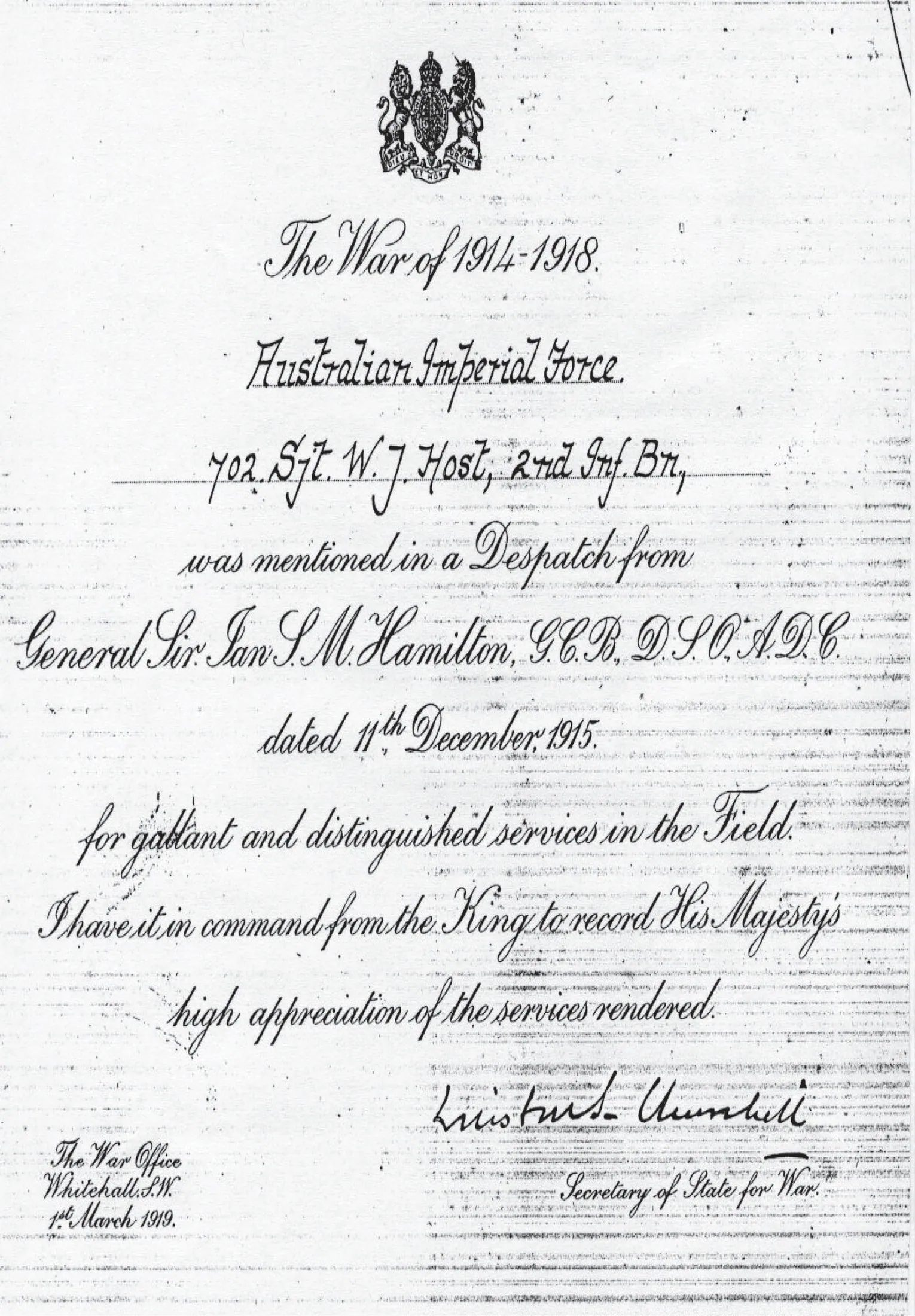
7-8 August 1915, Lone Pine Gallipoli
Signed by Winston S. Churchill
3c A Letter “from the Trenches”
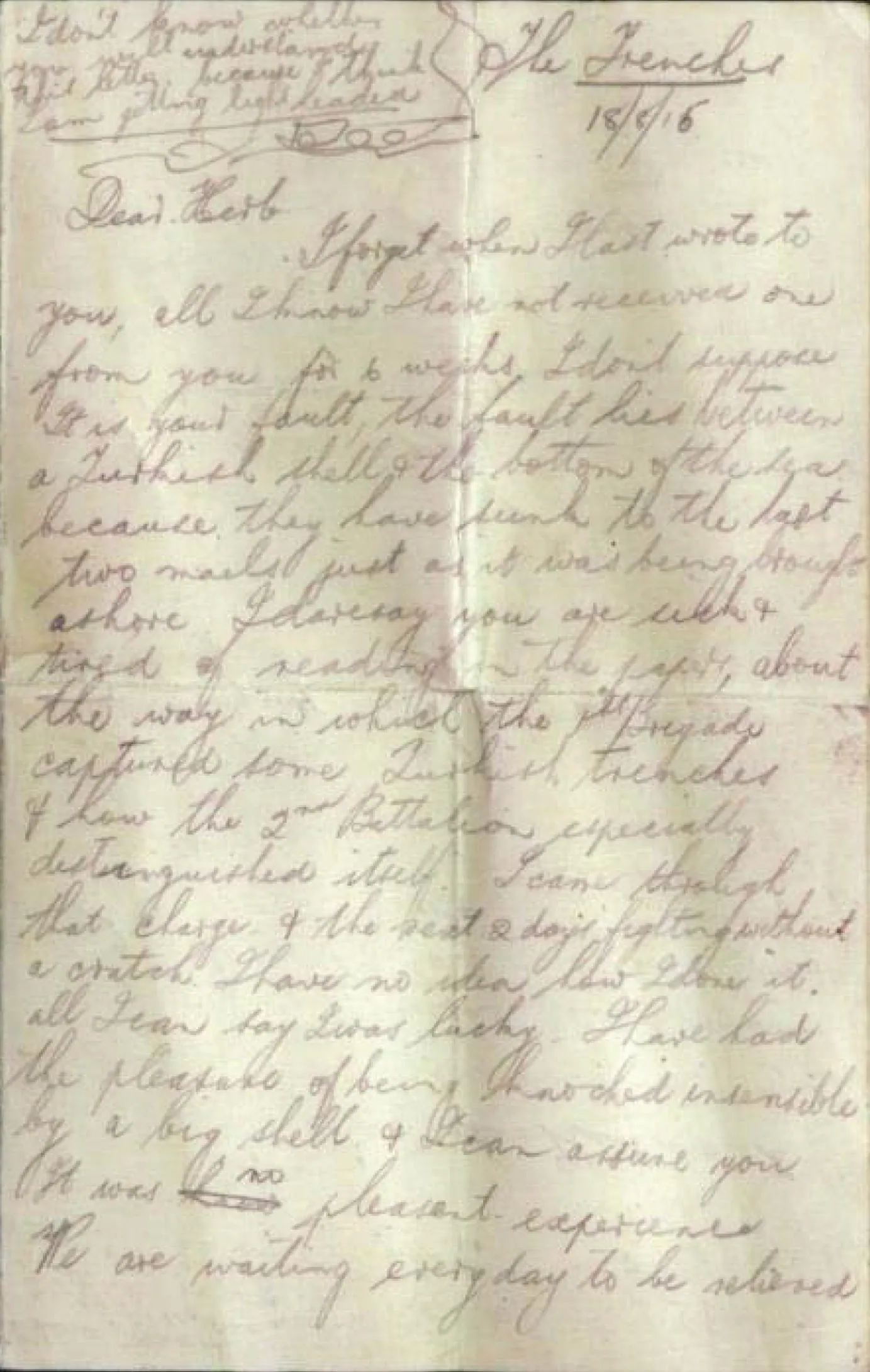
Following the action at Lone Pine, Walter Host wrote a remarkable letter to his brother Herbert. The letter, addressed, “From the trenches” was dated August 18, 1915 and was composed less than two weeks after Lone Pine. The letter, written after Walter had “spent 17 weeks in the trenches in one spell”, had a curious stream of consciousness quality about it since, as Walter latter added a foreword, he did not know if his brother would understand the letter “because I think I am getting a bit light headed”.
The letter begins with the assault on Lone Pine which Walter admits he had survived without a scratch even though he “did not know how he had done it”. Incidentally, Walter reveals that he had been injured for a second time during the Dardanelles campaign because he “had the pleasure of being knocked insensible by a big shell & I can assure you it was know (sic - crossed through) no pleasant experience.”
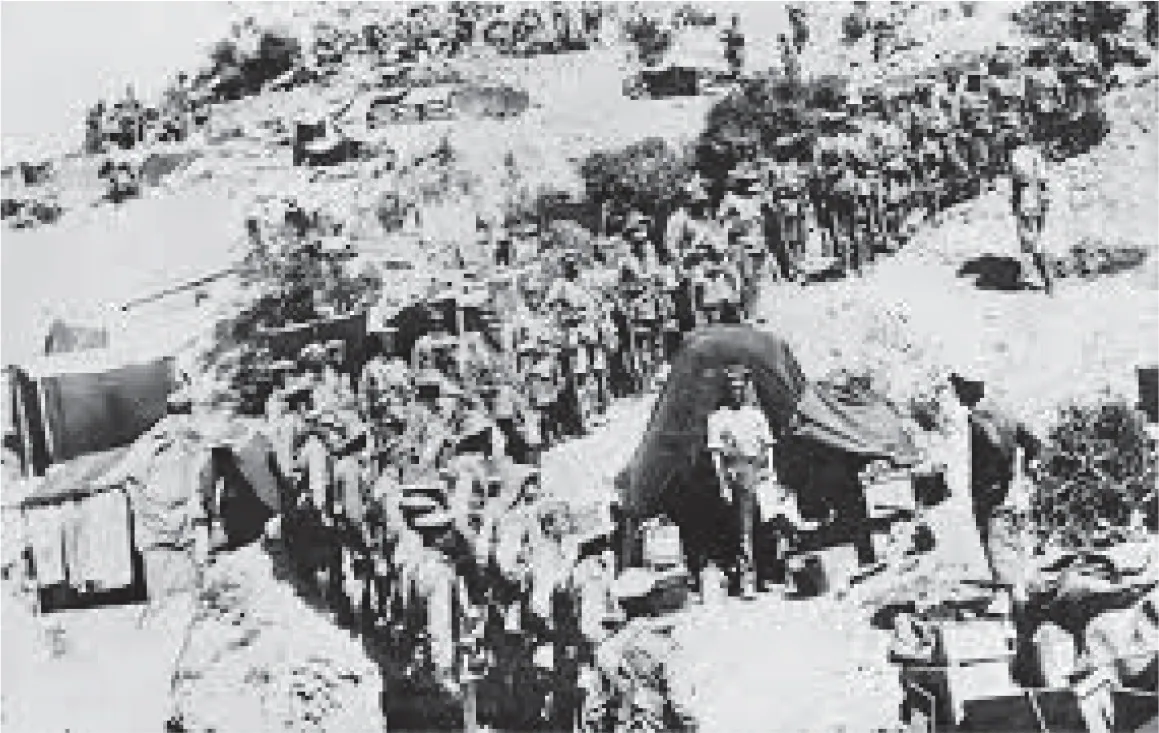
Walter then mentions that he had not had a night’s sleep for many weeks, this being one of his few complaints about the conditions he was enduring. Walter’s mind then slips into hazy dreaming in which he imagines that when he comes home he will lead a peaceful life, living “underground”, shooting only rabbits and using his periscope for one purpose only, namely “to watch the footer for nix”. This fantasy world reflects the real conditions which he was then enduring since, like the rabbits, the troops had been living underground in the captured Turkish trenches and using periscopes to snipe at the enemy. In the letter, the real war is transferred to a peacetime conflict of a football match and for a brief moment Walter is back in his quiet country village where he can watch a footy contest between teams “for nix” - with no charge or consequences.

away and he finally admits that he is “pretty tired”.
An exhausted Lone Pine warrior.
Loneliness then overtakes the teenager and for a brief minute he wishes that his brother could join him at the front. Then Walter realises the full horror of what he has written and warns Herbert that he must be careful to enlist only in the supply corps. Thus Walter imagines that his brother could join him at the front but only from a safe posting where he would be both well fed and protected from any real danger.
Finally, Walter dreams that he will soon be given leave and perhaps even relive the glorious summer in peaceful England where he had once spent several months in “playing soldiers”. However, reality returns and Walter warns his brother, who is managing his affairs in Australia, that “I will most likely be cabling for more cash as I intend to have a damn good time, as you never know when your last has come”.
This letter is a vision of a man who was by then clinging desperately to life and stretched almost to breaking point. At that time, suffering from the post traumatic stress of the shell explosion, Walter was also hanging on to sanity by sheer will and determination.
On August 18 1915 Walter Host wrote to his brother Herbert “from the trenches”. This letter came a month after Walter Host had been reported missing and was believed dead by his grieving family. When a second letter was received in November from the Island of Lemnos, Herbert finally dared to believe that his brother was still alive and he began a move to have Walter’s name restored to the official records amd the Army Pay Lists.
The Trenches 18/8/15
I don’t know whether you will understand this letter because I think I am getting a bit light headed Dear Herb “I forget when I last wrote to you, all I know I have not received one from you for 6 weeks. I don’t suppose it is your fault, the fault lies between a Turkish shell and the bottom of the sea because they have sunk the last two mails just as it was being brought ashore. I dare say you are sick & tired of reading in the papers, about the way in which the 1st Brigade captured some Turkish trenches & how the 2nd Battalion especially distinguished itself. I came through that charge & the next 2 days fighting without a scratch, I have no idea how I done it, all I can say I was lucky. I have had the pleasure of being knocked insensible by a big shell & I can assure you it was know (sic crossed through) no pleasant experience. We are waiting every day to be relieved as it is time

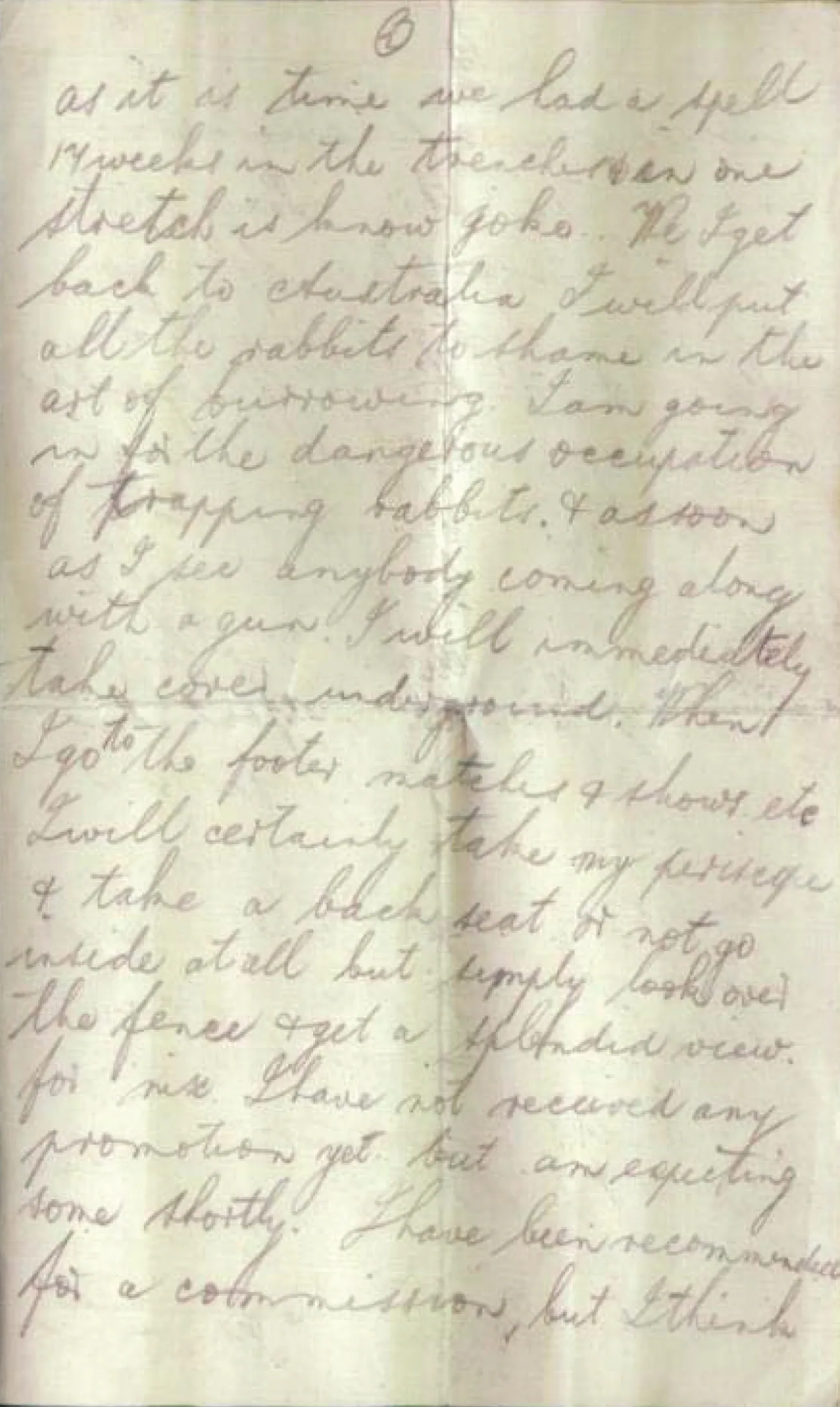
we had a spell. 17 weeks in the trenches in one spell is know joke. When I get back to Australia I will put all the rabbits to shame in the art of burrowing. I am going in for the dangerous occupation of trapping rabbits, & as soon as I see anybody coming along with a gun I will immediately take cover underground. When I go to the footer matches & shows etc. I will certainly take my periscope & take a back seat or not go inside at all but simply look over the fence and get a splendid view for nix. I have not received any promotion yet but am expecting some shortly. I have been recommended for
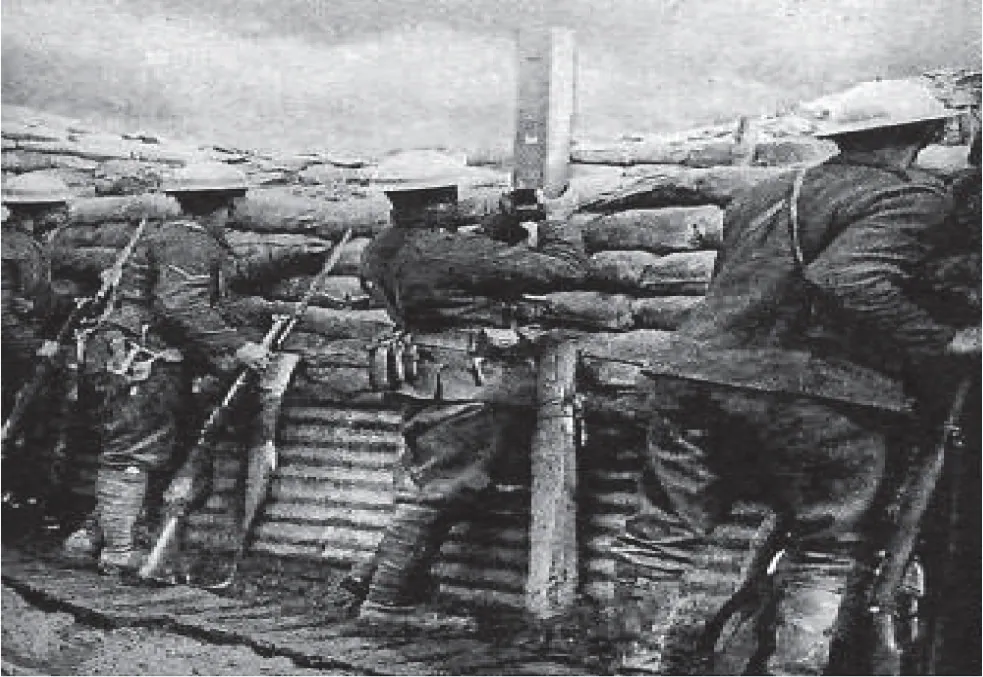
a trench wall In his letter Walter
imagines that one day he might use one
to see the footer games, “ for nix”.
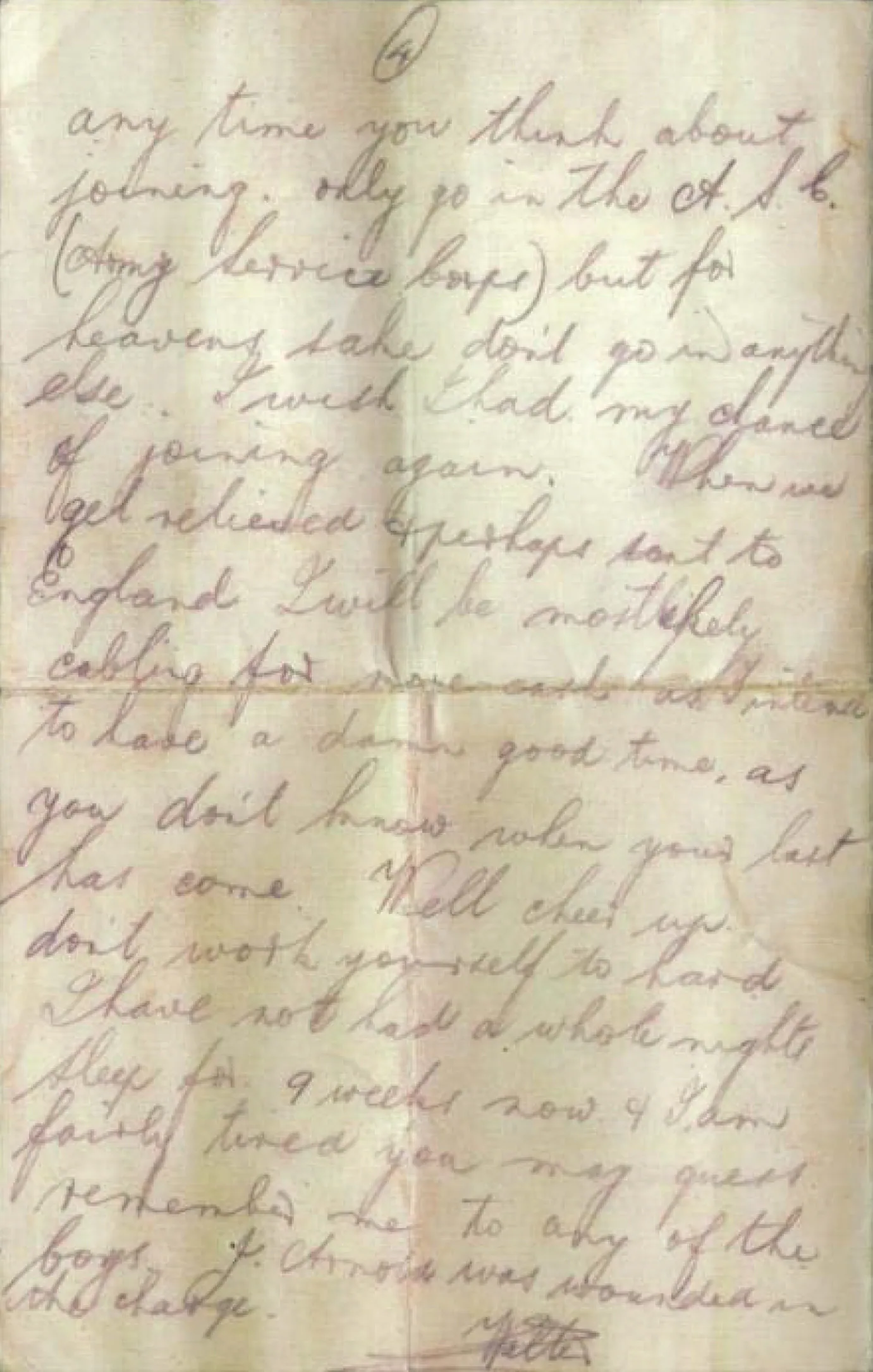
a commendation, but I think I will have to wait some time for the star. Next week I will be promoted Sgt. Major. I could not get promoted before as the former Sgt. Major has to be away 2 months before any promotion is allowed to take place. I have been acting honourable Sgt. Major this last week i.e. doing his work without his pay (12/- a day). I hope you have been getting my money alright it ought to be a nice little bit by now, I can hardly believe that it is over 12 months since I have joined the A I Forces, I sometimes wish you could see your
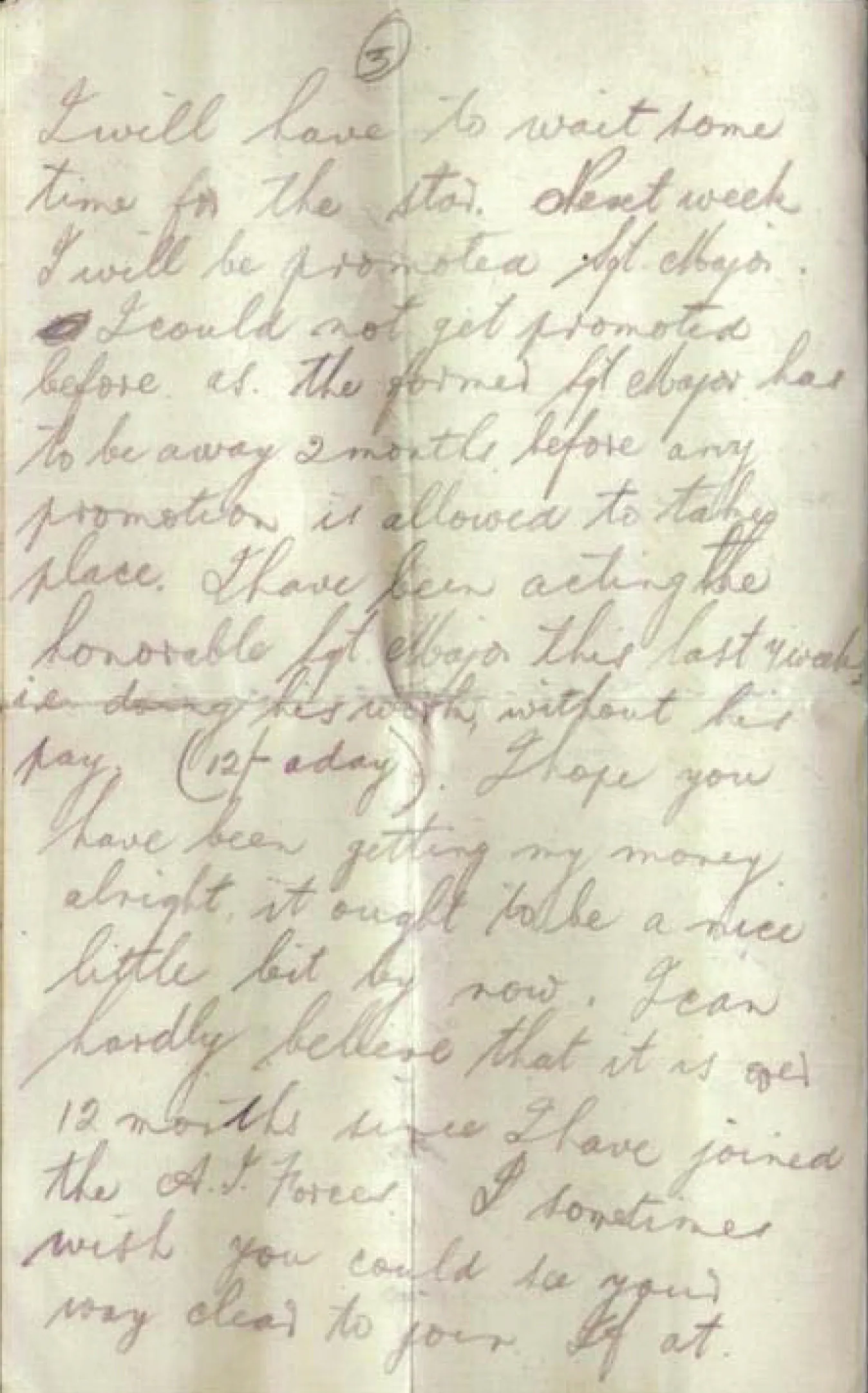


way clear to join. If at any time you think about joining only go in the ASC but for heavens sake don’t go in anything else. I wish I had my chance of joining again. When we get relieved perhaps sent to England I will most likely be cabling for more cash as I intend to have a damn good time, as you never know when your last has come. Well cheer up don’t work yourself to (sic) hard. I have not had a whole nights sleep for nine weeks now & I am fairly tired as you may guess. Remember me to any of the boys. J. Arnold was wounded in the charge.
consider joining the Army Service Corps -
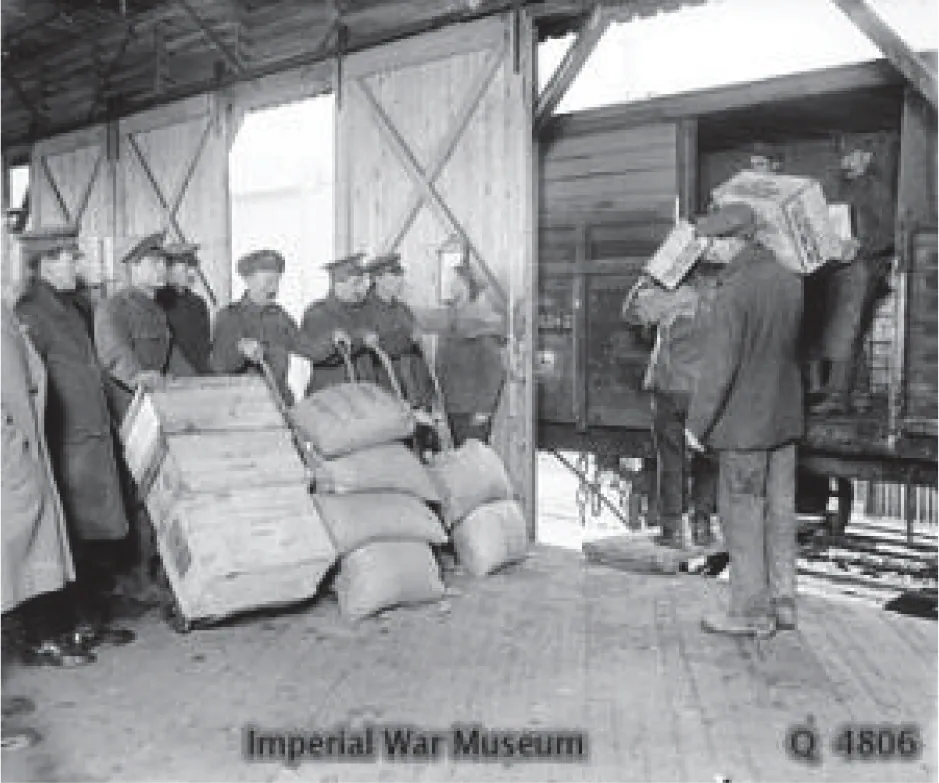
feats of logistics and were one of the great
strengths of organisation by which the war was
won.
(aka Ally Sloper’s Cavalry). In the Great War the majority of food, ammunition and supplies were supplied by the ASC. Using horses and motor vehicles, railways
Enjoyed this sample?
This is one of two free sample chapters. The complete book, with all its chapters and pictures, is available as a soft copy (digital download) for $49.95 or a hard copy for $59.95, postage included in Australia.